By Phoebe Farris (Powhatan-Pamunkey)
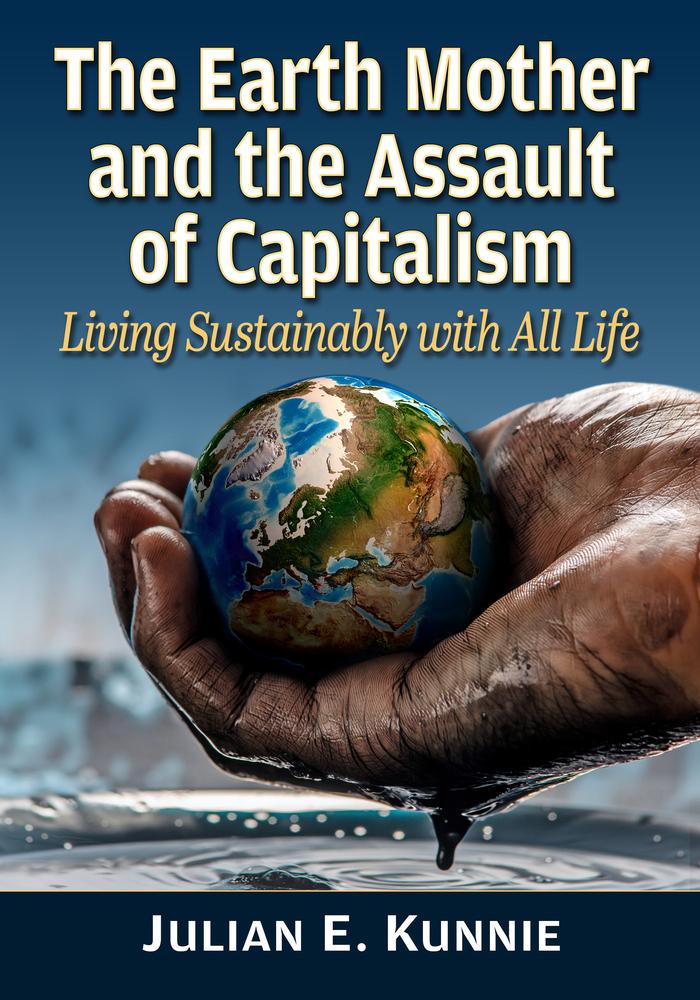
Dr. Julian Kunnie is a retired Professor of Religious Studies/Classics at the University of Arizona and an activist researcher, author, and advocate for Indigenous Peoples. His research focuses on a wide range of social justice issues, from youth incarceration to ecological restoration to defending all Indigenous Peoples and dispossessed communities against colonization and exploitation. His latest book, “The Earth Mother and the Assault of Capitalism: Living Sustainably with All Life,” was published in July 2025. Phoebe Farris, Cultural Survival Contributing Arts Editor, recently spoke with Kunnie.
Phoebe Farris: How did you prepare yourself to delve into the complexities of understanding, researching, and writing about major global issues, and do so with respect for the diversity of knowledge, especially Indigenous knowledge, often dismissed by academia?
Julian Kunnie: Thank you for these important questions. We use the term “we” in the authorship of our book because every book is the result of a collective process, beginning with the Earth Mother and the Beginningless and Endless Spiritual Universe. The Spiritual Universe is the ultimate power, teeming with life in infinite forms. Humans are only one small but significant part.
Western academia is rooted in a spiritless worldview that elevates the human intellect above the spiritual. For Indigenous Peoples, the mind is an element of Spirit, emanating from the Universe and the Earth Mother. Thus, any academic reflection must be grounded spiritually. The Earth Mother informs our ability to think, determine, and reflect; She outlives all human intellectual constructions. We recognize that academia is limited and must be decolonized and liberated.
After decades in academia and deep involvement in Indigenous communities across Turtle Island, Africa, and elsewhere, we have learned that “research” often serves the researcher more than the community. Western research has been extractive. Anthropology, archaeology, and paleontology have removed Indigenous remains and knowledge without consent. This extraction is colonial predation and must be abolished.
Indigenous knowledge is transmitted through ancestral languages, rooted in cultural histories and not dependent on literacy. Elders around the world often have clearer grasps of how the Earth and life function. What western society calls “science” is often scientism posing as truth but conditioned by ideology, culture, and limited temporal understanding. Indigenous cosmologies are cyclical, fluid, verb-based, recognizing that knowledge unfolds continuously. We see ourselves as children of the Earth Mother who return to Her when our physical form ends. The book is Spirit-based because intellectual ability is ultimately subordinate to the power of the Earth Mother and ancestral wisdom.
PF: Why did you choose to ground your research and writing in spiritual beliefs, giving them equal recognition to your bibliography and chapter notes?
JK: Indigenous Elders granted us permission to share the knowledge in this book. Some knowledge is not meant to be published, especially sacred stories restricted to their communities. We honor those boundaries. Many Elders, like Nowipi in the Philippines, wanted their teachings shared with the world to help others. The process of writing about Indigenous knowledge is always slow and deeply respectful.
Indigenous spirituality is not an optional addition; it is the foundation. Western academia’s rejection of spirituality reflects its limited cosmology. For Indigenous Peoples, Spirit, Earth, and mind are inseparable. Knowledge arises from experience, ceremony, community, land, and ancestors.
PF: What was your process for obtaining permission from various Indigenous Elders, wisdom keepers, shamans, and priests to share their spiritual beliefs?
JK: We always requested permission from Elders before sharing anything in writing. Some teachings were given freely with encouragement to share widely; others were explicitly restricted. Elders clearly guided what should be shared and what must remain within their communities. This process requires humility, cultural respect, presence in community, and a recognition that we are all children of one Earth Mother. Permission is earned through relationships, responsibilities, and ongoing involvement with Indigenous Peoples, not through academic entitlement.
PF: One of the chapters highlights the presence of ancient gender fluidity in many cultures long before contemporary debates. How do you feel about western youths misappropriating the term ‘Two-Spirit’?
JK: Indigenous cultures do not accept rigid gender binaries. Gender is complementary, fluid, inclusive, and spiritually rooted. Two-Spirit people possess spiritual qualities of both female and male, and are respected for the harmony, insight, and gifts they bring to their communities. Two-Spirit identity is spiritual, not a political tool or social trend.
Western societies, due to their spiritual and cultural impoverishment from imperialism and capitalism, frequently appropriate Indigenous concepts without understanding. Using Two-Spirit as a political identity detached from Indigenous ceremony, tradition, and community is a misappropriation. Two-Spirit people must be understood through Indigenous frameworks, not western activism.
PF: What are some of the common threads linking the oppression of diverse peoples historically, and today?
JK: The modern world is the result of 532 years of genocide, enslavement, colonization, conquest, and capitalist exploitation led by Western European violence. Nearly 7 billion people of color worldwide live with the consequences of land dispossession and slavery carried out by imperialist regimes and corporations.
Today’s wealth is built on the impoverishment of the Global South—Africa, Asia, the Americas, the Caribbean, and island nations. The Earth Mother’s children—humans, animals, plants, oceans—suffer due to extraction industries that take oil, minerals, and water for western affluence. The military-industrial complex punishes any nation that resists.
Affordable housing and healthcare are disappearing in capitalist states like the U.S., South Africa, South Korea, and India. Programs for the poor are slashed while corporations accumulate trillions. The high-tech industrial complex deepens human suffering by enforcing digital dependency, especially among youth.
PF: How is oil production impacting Turtle Island, especially on reservations and reserves?
JK: Oil extraction has devastated Indigenous lands across Turtle Island. Indigenous peoples remain impoverished while their ancestral territories are poisoned. Cree communities in Alberta suffer cancers from tar sands extraction. The Athabascan water system is destroyed by Syncrude and Suncor Energy. Thacker Pass (Peehee Mu’huh), sacred to the Paiute and Shoshone, is desecrated by lithium mining, violating treaties such as the Treaty of Ruby Valley.
Fracking in Texas and Oklahoma has caused thousands of earthquakes. The U.S. and Canadian governments continue uranium and coal mining on Indigenous lands despite environmental protections. These actions accelerate Earth heating, water contamination, species extinction, and climate destabilization.
PF: How do you define chem trails in language accessible to non-scientific readers?
JK: Geoengineering programs attempt to reduce sunlight by spraying chemical particles (aluminum, barium, strontium, polymers) into the atmosphere from aircraft. These chemical sprays alter rainfall patterns, disrupt hydrological cycles, weaken root systems, reduce the ozone layer, dry out the Earth, increase wildfires, [and] contaminate water and soil
Government agencies call them “contrails,” describing them as harmless ice crystals, but their chemical composition and environmental impacts contradict that explanation. They contribute to global weather chaos and climate collapse.
PF: In Chapter 5 of the book, "Capitalism’s Persistent Devaluing of Public Education and the Need for Restructuring and Reorienting Education", you discuss “decolonization education” and one of your examples is the Yuchi Language Project and school on Glenpool, Oklahoma, created/developed by Dr. Richard A.Grounds( Yuchi/Seminole) who serves on the Board of Directors at Cultural Survival. What were your reflections from visiting the Yuchi Language Project in Oklahoma?
JK: The Yuchi Language Project is a model for decolonized education. Elders teach the children to speak Yuchi; young teachers, parents, and community members participate fully. We visited the school in summer 2023 with partner Kim, an elementary teacher herself, and witnessed young children speaking Yuchi proudly and confidently.
This is decolonization in action: reclaiming one’s language, culture, and worldview as the foundation of education. Seeing children thrive in their Indigenous language brought hope that Indigenous youth across Turtle Island can renew their cultures and build a meaningful future grounded in their ancestors.
Chapter 5 reflects on the impact of capitalist greed on education in Turtle Island in general, and what we refer to as “higher education” in particular, with a total corporatization of learning and recolonization of learners through technology and forced indebtedness on learners due to escalating costs of college, while eliminating trained staff and slashing public educational budgets. The decolonizing of educational structures and curricula is asserted at the core of the chapter, with emphasis on the reclamation of Indigenous languages at the heart of transformative curricula. The case of the Yuchi Language Project in Glenpool, Oklahoma, spearheaded by elders and Sushpa (Richard Grounds, who serves on the board of Cultural Survival and is a leading global Indigenous languages and cultures educator), is highlighted. We had the opportunity to spend some time at the Yuchi School in the summer of 2023 with partner, Kim, an elementary school teacher herself. It’s wonderful to see young Yuchie children being taught by elders and other young Yuchie language teachers to speak and know the language, with parents and family fully involved in their children’s education. This is what decolonization is all about: Reclaiming one’s Indigenous ancestral language and being reschooled in one’s ancestral culture so that one can live in harmony with one’s community and live out ancestral knowledge in the present and continue those traditions and languages into all future generations: our great-grandchildren’s great-grandchildren and beyond! This is the hope of the Indigenous peoples and nations, indeed of all peoples of the world, particularly the youth, who desire living in a peaceful and constructive world where sharing and caring are foundational ways of living.
PF: How has Indigenous language reclamation affected you personally? What Indigenous languages do you speak or understand?
JK: Reclaiming our ancestral Nguni languages—isiZulu and isiXhosa—connects us to ancestral teachings and wisdom. These languages hold profound philosophies, such as Kusinwa Kudedelwana: “Dancers dance and give way to others; life is a stage and people come and go.” It teaches humility and impermanence. Colonization attempted to erase these languages, but reclaiming them restores wholeness and empowers future generations. It is a lifelong calling.
PF: Do you foresee Indigenous land restoration happening in our lifetime?
JK: Land restoration is difficult and long-term. The Earth Mother is indomitable; She ultimately prevails. She grieves over all stolen Indigenous lands—Turtle Island, Africa, the Pacific, the Caribbean, West Asia, and everywhere colonization has taken root. Will full restoration happen in our lifetime? Perhaps not. But the movement is growing. A re-spiritualized, decolonized Earth is possible if we defend the Earth Mother and support Indigenous leadership steering humanity back to balance.
PF: Are there any final thoughts you’d like to share?
JK: “No matter where you stand on the Earth, you’re home.” We are all relatives—humans, animals, birds, insects, oceans, mountains, trees, rocks. We belong to the Earth Mother. We must reclaim Indigenous languages, honor our ancestors, and work toward a world where all life can thrive with dignity, harmony, and hope.
Ajo! Busis’! (Blessings!)
--Phoebe Farris (Powhatan-Pamunkey descent) is Contributing Arts Editor for the Cultural Survival Quarterly magazine. An art critic, curator, author, and photographer, she has written extensively on Indigenous visual, literary, and performing arts for over two decades. Farris is also a Professor Emerita of Art and Design at Purdue University and has curated and contributed to exhibitions highlighting Native and global Indigenous artists. Her work bridges scholarship, creative practice, and advocacy, amplifying Indigenous voices in contemporary art and media.